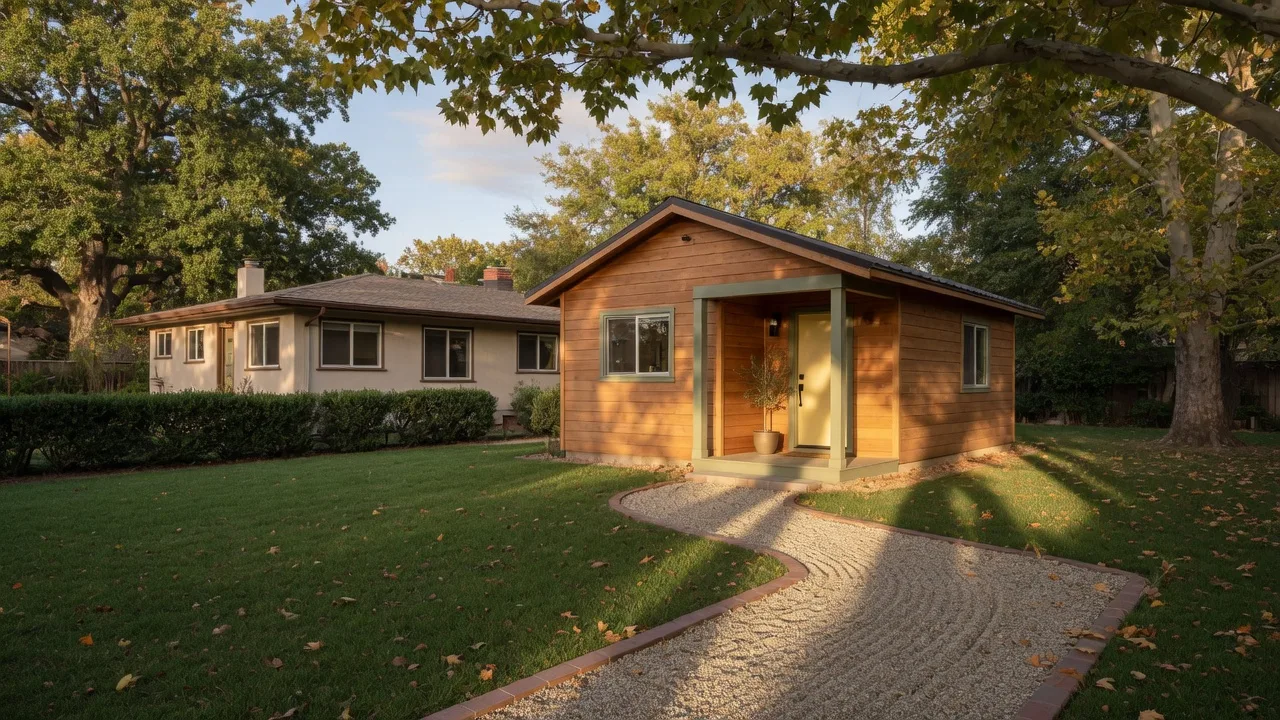
A few Septembers ago I stood in an East Sacramento backyard behind a 1940s bungalow and watched a young couple add up the numbers out loud. A garage on that lot had been finished into a one-bedroom unit and rented to a nurse who worked nights at the medical center. The rent covered their truck payment, their daughter's preschool, and a solid slice of the main house payment. That converted garage was the most valuable room on the whole street, and it had never been part of the listing photos. This post is about building that room on purpose: what an accessory dwelling unit costs to build in this region, what it rents for, and what has changed in the last two years that makes the whole idea worth another look.
What the City Lets You Put in the Yard Now
Start with the basics, because the names trip people up. An accessory dwelling unit is a second complete home on a lot that already has one. In Sacramento city code it goes by ADU, and it comes in two flavors. Detached means it stands on its own, and the city allows up to 1,200 square feet. Attached means it shares a wall with the main house, and it can run up to half the size of the primary home, capped around 850 to 1,000 square feet depending on the bedroom count. There is also the junior version, the JADU, tucked inside the existing walls of the main house, up to 500 square feet, which is how a lot of people convert a formal dining room nobody ate in.
The part that surprises the people I walk through it: you do not need the city's blessing as a special favor. ADUs are allowed by right here. If your lot has a house on it, the second unit is a permitted use, not a fight. Setbacks for a detached unit are four feet off the side and rear lines, the height can go to at least sixteen feet, and under the current rules no extra parking spot is required for the new tenant. None. That was the old deal-breaker, and it is gone.
The approval clock is real, too. The city has to say yes or no to a complete application within 60 days. And because units under 750 square feet are exempt from development impact fees, most backyard builds skip the biggest bucket of city charges. The city even hands out free, permit-ready ADU plans if you want to build from an approved set instead of paying an architect. That last part should tell you something: this is a city that decided it wants more of these.
The Rule Change Nobody Led With
Here is what actually moved the market, and it was quieter than the headline-numbers stuff. California dropped the owner-occupancy requirement. For years the common setup was: you had to live in one of the two units, which filtered out investors and out-of-town owners. That rule is gone. You can build the unit, rent out the main house, and live in the smaller one, or rent both. State law also took swings at the HOAs that used to kill these projects at the door, cutting the penalties tied to unit size and moving toward allowing two detached ADUs on a single lot. I wrote about the latest round of those laws in my September market letter, and they matter most to the older neighborhoods where the garages are already in place.
State law stops an HOA from flat-out banning an ADU, but it gets a say on the details, and this is where I sound the caution. Master-planned communities in the newer corners of the region write their own rules about rental units, minimum lease terms, and who can occupy what. If you are buying in a community association, the CC&Rs you read at closing decide more about your backyard than the state law does. I covered the second tax that rides along with a lot of those new communities in the Mello-Roos post, and the HOA rules sit in the same envelope.
One more geography note. Sacramento city has its own program, and so does every city around it. Roseville, Folsom, El Dorado Hills, and the counties all wrote their own ADU rules, and they are not the same as the city's. Same state law, different local details on setbacks, parking, and fees. Before you design around any number in this post, call the building department in your specific city and ask them to run the lot address through their rules. Twenty minutes of phone time beats a permit denial.
The Price of a Second Front Door
Building runs about $200 to $400 a square foot right now, which is a wide band because the difference between tract-built and custom is exactly there. The numbers clients actually see, in round terms: a studio of 300 to 400 square feet lands around $80,000 to $120,000. A one-bedroom of 500 to 700 square feet runs $120,000 to $180,000. A two-bedroom in the 800 to 1,000 square foot range is $150,000 to $225,000. And the cheapest honest path is the garage conversion, taking an existing 500-square-foot garage and finishing it, which comes in around $80,000 to $150,000 because the shell and the roof are already bought and paid for.
The permits stay small next to the build. A typical all-in city bill lands somewhere around $3,000 to $11,000, with the building permit itself running in the low four figures plus plan review. Remember the free permit-ready plans? That saves the $5,000 to $15,000 an architect would charge for a design from scratch. Paying for a decent set of plans is worth it for a lot of lots, but building from the city's pre-approved sets is a legitimate shortcut, not a corner cut.
The hidden line on the build is the utility work. A 200-amp electrical panel upgrade, a separate meter, sometimes a sewer or water trench across the yard. Contractors call these the allowances that never survive contact with reality. Get your quote to spell out the panel, the meter, and the hookups line by line, and hold 10 percent for surprises. On every single ADU I have watched get built, the surprises showed up somewhere between the permit and the paint.
The Rent Side of the Ledger
Now the number everyone wants first. A detached unit around 600 square feet rents in the $2,000 to $2,500 a month range in this region. Garage conversions pull $1,800 to $2,200. One-bedrooms in established neighborhoods commonly list between $1,500 and $1,850. The neighborhoods track the map you expect: Midtown units push $1,600 to $2,200, East Sacramento and Land Park sit at $1,500 to $2,100, Natomas and Arden-Arcade run $1,400 to $1,900. For scale, the average apartment rent in Sacramento sits right around $1,800 to $1,900 a month, so a well-built ADU prices like a proper apartment, except it comes with a yard, a driveway, and no shared laundry room.
The purchase math is friendly as long as you do it honestly. Say you finance the middle-of-the-road build, $180,000, at today's rates. The payment runs roughly $1,250 to $1,400 a month depending on your rate and term. The rent on that unit at $2,200 covers it, and the difference is your cushion for vacancy, maintenance, and the years rent does not cover. Most builds pencil out on a five-to-ten year horizon, which is longer than the YouTube videos promise and shorter than the thirty-year mortgage on the main house.
Two cautions from the lending side before you get excited. Most lenders will not count the future rent when they qualify you for the loan to build it. They want two years of tax returns showing the income actually arrived. And the county will add the new structure to the property tax roll with a supplemental bill for its value, so the annual cost of ownership includes a tax line that was not there the year before. Neither kills the deal. Both belong in the budget.
Where the Good Math Goes Bad
I have seen enough ADUs to keep a short list of the ways the plan unwinds, and here it is. The septic tank is first. On a well-and-septic lot in Loomis, Auburn, or out in the county, the septic system has to be able to handle the second bathroom, and the county health department decides that, not the seller, not the contractor, not me. The capacity test comes before the permit, so get it done before you pay for plans.
The HOA is second, and I already named it. Rental caps, lease minimums, approval committees. Some of the region's most family-friendly communities simply are not built for a rotating cast of neighbors, and the CC&Rs will tell you so plainly if you read them.
Insurance is third, and it ties back to a theme I have spent a lot of this year writing about. A rental unit is a different risk than a spare bedroom, the carrier wants to know, and the premium jumps accordingly. In the foothill towns the fire insurance conversation I covered in Fire Insurance Is the New HOA applies to the new structure too, and the mitigation standards follow the same playbook.
And the contractor is fourth. The ADU boom pulled a lot of builders off roofs and couches into garages, and the quality spread is wide. Check licenses, ask for three finished ADU addresses in this region, and drive past them. A bad foundation under a rental unit is a bad foundation under your retirement income.
Three Questions Before You Call Anybody
The rest is just paperwork, and it collapses into three questions. Ask them in this order and the project either gets real or goes away.
Does this exact lot qualify on paper?
City rules, setback lines, HOA CC&Rs, septic capacity if you are outside the sewer. One call to the building department plus one read of the HOA packet answers it.
What would this build rent for, in writing?
Run three comparable listings for units of the same size in your own zip code. If the honest rent does not cover the honest payment, the project is a hobby, and you should know that going in.
Who lives there while it pays for itself?
A parent, a grown kid, a traveling nurse, a long-term renter. The human answer decides the floor plan, the finishes, and the lease, and it is the question most people skip.
Your timeline works in your favor this month, too. A fall permit means the build lands in the spring and the unit rents through its first summer, which is the strongest rental season of the year. The neighborhoods where this works best are the ones with older lots and bigger yards, the same East Sacramento streets I have been showing for 37 years, plus Land Park, Tahoe Park, and the established corners of Roseville and Folsom where the garage is already standing.
Let's Run the Numbers on Your Lot
I have sold homes with ADUs, sold lots made for one, and watched the builds go right and wrong for 37 years. Bring me the address and I will tell you what the lot allows, what the honest build costs, and what the finished unit rents for on today's market before you spend a dollar on plans. Start with a no-obligation home value read, and we will go from there.
Talk to you soon.