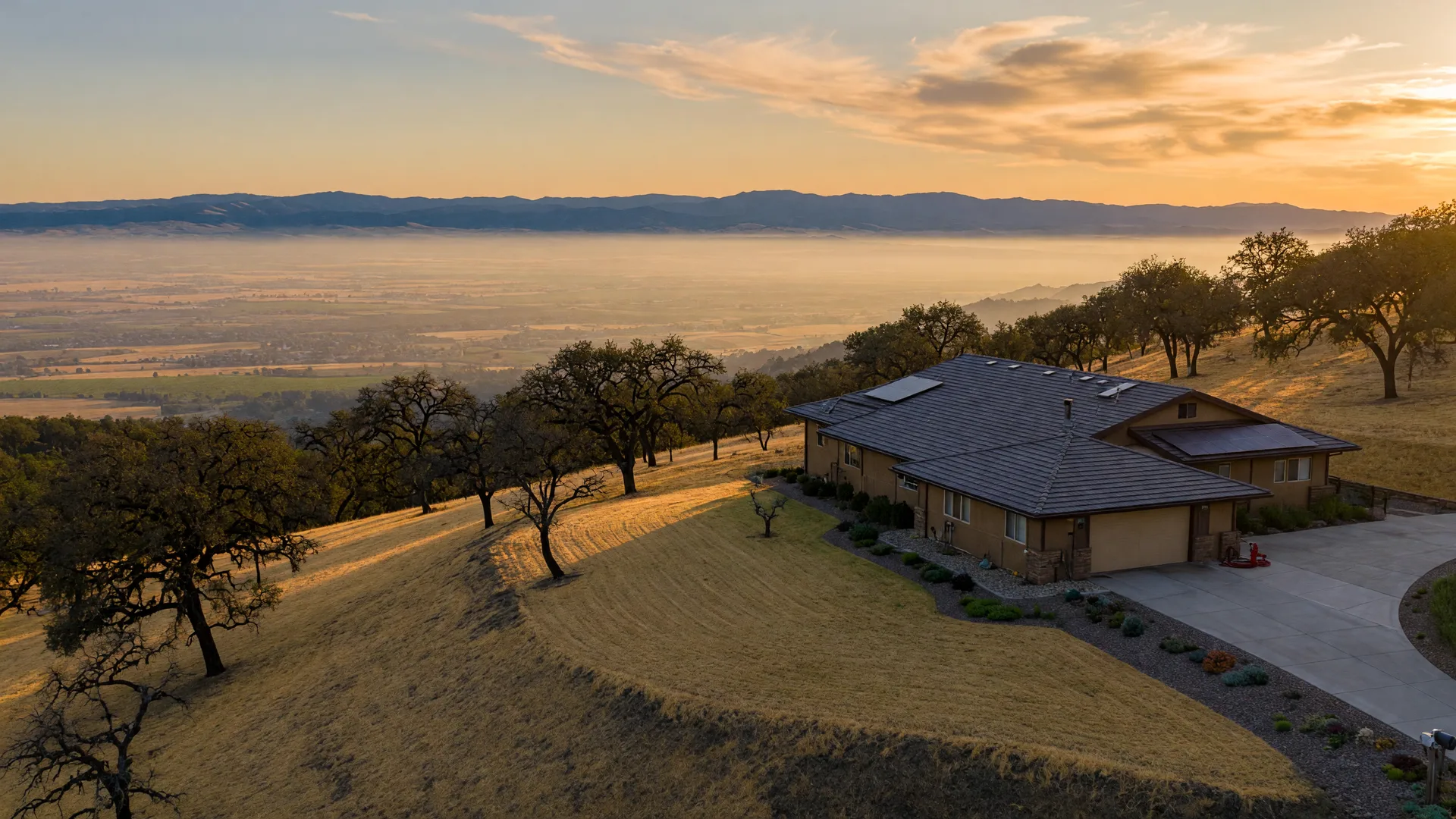
Here is the question I have heard at least once a week since last year: how did the house I can afford become the house I cannot get insured? The short answer is that fire insurance has turned into the deciding line of this market, and it now works a lot like an HOA. You cannot skip it. The address sets the bill, not you. It comes with yard rules and inspections you never agreed to ask for. And the number can jump, which is a lot like a special assessment, except there is no board meeting. In this region the same floor plan runs about $1,300 a year to insure on the valley floor and $12,000 or more back in the trees, and that gap is quietly deciding who can buy where. This is the plain version of how the new numbers work, and what to check before you offer.
The Number the Listing Never Shows
Every listing shows the price, the square footage, and the HOA dues if there are any. None of them show the insurance quote, and these days that quote can be the biggest line in the whole budget. Your lender decides that line before you ever see the key. No policy, no mortgage, full stop. The insurer is paid out of your escrow like property tax is, and you find out what the number actually is sometime between the offer and the closing table, which is exactly the wrong time to find out.
Think about it the way you would think about a HOA, because the shape matches. You opted in by buying the house, not by reading fine print. The monthly cost is tied to the address, so when you sell, the next buyer inherits the same reality. The neighborhood decides the bill more than anything you do. There are rules about your property, and staff who can inspect your yard. The only real difference is that a HOA board is elected. Your insurance contract was written by an actuary in a city you have never visited.
Two houses I showed this month make the point. Same builder, same floor plan, same decade, same price within $10,000. One sits in a Roseville master plan on the valley floor. The other backs up to an oak ridge in the foothill interface. The first quotes around $1,500 a year. The second quotes near $8,000. Same family, same budget, same size of home. Only the address changed, and the address is worth about $550 a month.
Why Every Number Is Moving at Once
The January 2025 fires changed California the way two bad harvests change a crop farmer. Homeowners insurers paid out billions, then slowed or stopped writing new policies while they re-priced the whole state. State Farm's emergency 17 percent increase was made final in a March 2026 settlement, and the range of increases across carriers kept climbing through the year.
The state's safety net grew to match. The FAIR Plan, the insurer of last resort, now carries roughly 700,000 policies, about one in ten California homes. And in just under two weeks, on October 15, 2026, the largest rate increase in the FAIR Plan's recent history kicks in: 29.1 percent on average across its dwelling line. That is an average, not a promise. Homes in the highest-risk addresses pay well above it, and some quotes people are hearing sound like they doubled.
The FAIR Plan covers less, too. It is fire coverage first, not a full homeowners policy. When you read quotes that look cheap, read the coverage list that comes with them. In fire country, the FAIR Plan is a bridge, not a home.
The Three-County Map, From the Valley Floor Up
CAL FIRE draws the hazard zones, and the state fire maps put the wildland edges of our foothill towns in the High and Very High zones while most of the valley floor stays Moderate or unzoned. The maps do not set your rate, and the insurance commissioner says so plainly: carriers price with their own models, house by house. But the shape of the map tells you where the expensive quotes live. These are the ranges I watch, not quotes, because every address is its own number.
| Area | Fire zone shape | Typical annual premium |
|---|---|---|
| Roseville, most of Sacramento County | Mostly valley floor, moderate | $1,200-$3,200 |
| Folsom lakefront, Willow Creek, parkway edges | High to very high | $5,000-$12,000+ |
| El Dorado Hills | High to very high along ridgelines and canyons | $5,000-$12,000+ |
| Granite Bay lakefront parcels | High to very high at the wildland edge | $5,000-$12,000+ |
| Auburn | High to very high in parts of town | $5,000-$12,000+ |
Premium ranges are what carriers and local agents commonly see in 2026 for a standard coverage package, and they swing with the carrier, the house, and the exact parcel. The FAIR Plan for extreme-risk addresses can run $5,000 to $25,000 or more. Every address is its own number.
The details under those rows matter more than the rows. Folsom adopted the updated CAL FIRE map in spring 2025, and the high and very high zones sit along Folsom Lake and the American River Parkway edges, which is where a lot of the pretty house hunting happens. Community risk trackers put the share of El Dorado Hills properties carrying some wildfire risk near 99 percent. Granite Bay's steepest quotes hug the lakefront parcels, and the Placer foothill fringe above Roseville catches the edge of the same zones.
And here is the part that connects to everything I have written about the fog line: the hills that stand above the December fog are the same hills that carry the heavier insurance quote. Same geography, same line on the map. I wrote the full Granite Bay versus El Dorado Hills comparison, and the insurance gap is now part of that decision for every family I walk through it.
The Yard Rules Are in the Contract Now
Here is what the HOA comparison teaches that pays: the rules are not optional anymore, and following them actually lowers the bill. California's Safer from Wildfires program, in place since 2022, requires insurers that price for wildfire risk to give documented discounts for mitigation work. The usual range is 5 to 20 percent off the fire portion of the premium, and the FAIR Plan now stacks up to a dozen separate discounts, worth roughly 13.8 percent off its dwelling line when you have done them all.
The work itself is plain. A Class A fire-rated roof. Ember-resistant vents so the house does not pull fire in through the attic. Vegetation cleared back from the walls, and the five feet right against the house, what the fire folks call Zone 0, kept down to bare ground or low, watered plants. Decks cleared of debris underneath. It is not glamorous, and it is not a sales pitch. It is the difference between a quote the family can live with and a quote that kills the deal.
Keep the receipts and the photos. The discounts transfer to the next owner when the work is documented, which makes mitigation paperwork a resale asset. I have sold enough of both to tell you which one buyers ask about first now.
The Rules That Just Changed in Sacramento
The governor signed a wildfire insurance package in late September, and three parts matter to anyone reading this. Nonrenewal notice moves from 75 days to 90 days, so a carrier that is leaving your address has to say so earlier. Claims handling during an emergency gets new standards, and so does the testing for smoke and contamination damage, which was a battleground after the LA fires. None of these lower your premium. All of them make the process less of an ambush.
The other protection is the one-year moratorium. When a fire is declared an emergency, California law blocks cancellations and nonrenewals for twelve months in the affected area. The rule is alive because fire season is alive. In August, the Gann Fire burned just over 10,000 acres in Calaveras County, about an hour from downtown Sacramento, destroyed 45 homes, and triggered evacuation orders near San Andreas and Angels Camp. It also triggered a fresh reminder here that the risk is not a coastal problem. It is the line of oak trees behind a Granite Bay lot.
There is an opening, too. Travelers became the first top-ten insurer to commit to writing more coverage in fire-distressed areas under the state's Sustainable Insurance Strategy, in April 2026, and two more big carriers followed by May. The door is not shut. It is narrower, and it swings on paperwork.
What to Do Before You Offer
Insurance stopped being a back-office detail and became a due diligence item, like a roof or a sewer line. Do these before you write an offer, not after.
01
Get a quote with this exact address
Asking about the zip code is how you get a surprise. Ask about the street address, and let the carrier run its own model on it.
02
Ask the seller for the declaration page
The current policy, the carrier's name, the annual number. Then ask whether a nonrenewal has been filed. A seller with a drawer of denial letters is a seller with a story.
03
Read the natural hazard disclosure
California's standard disclosure tells you if the property sits in a very high fire hazard severity zone. Read it like you read the roof report.
04
Ask about the roof and vents before you love the house
A Class A roof and ember-resistant vents are discount triggers. A composition roof with open vents is a bill trigger. Twenty minutes of questions.
05
Run the monthly math out loud
$8,000 a year is $667 a month. Put the insurance line in the same budget column as the mortgage and the Mello-Roos before you decide what you can afford.
Or just bring me the street
I have sold on both sides of the insurance line for 37 years, and I know which streets renew and which streets fight. Thirty minutes and we will know what the address actually costs.
Let's Check the Insurability Before You Fall for the House
The days of finding out the insurance number at the closing table are over, and I will not let a client walk into that ambush. Whether you are buying on the valley floor, at the lake's edge, or in the oaks, I will tell you which addresses quote clean and which ones carry a fight, and who is writing policies in this region right now. Out-of-state buyers should start with my relocation guide, which covers this from the first phone call.
Also the straight answer for sellers: if you have done the mitigation work, I will make sure the listing says so, and the next buyer will pay you for it.
Talk to you soon.