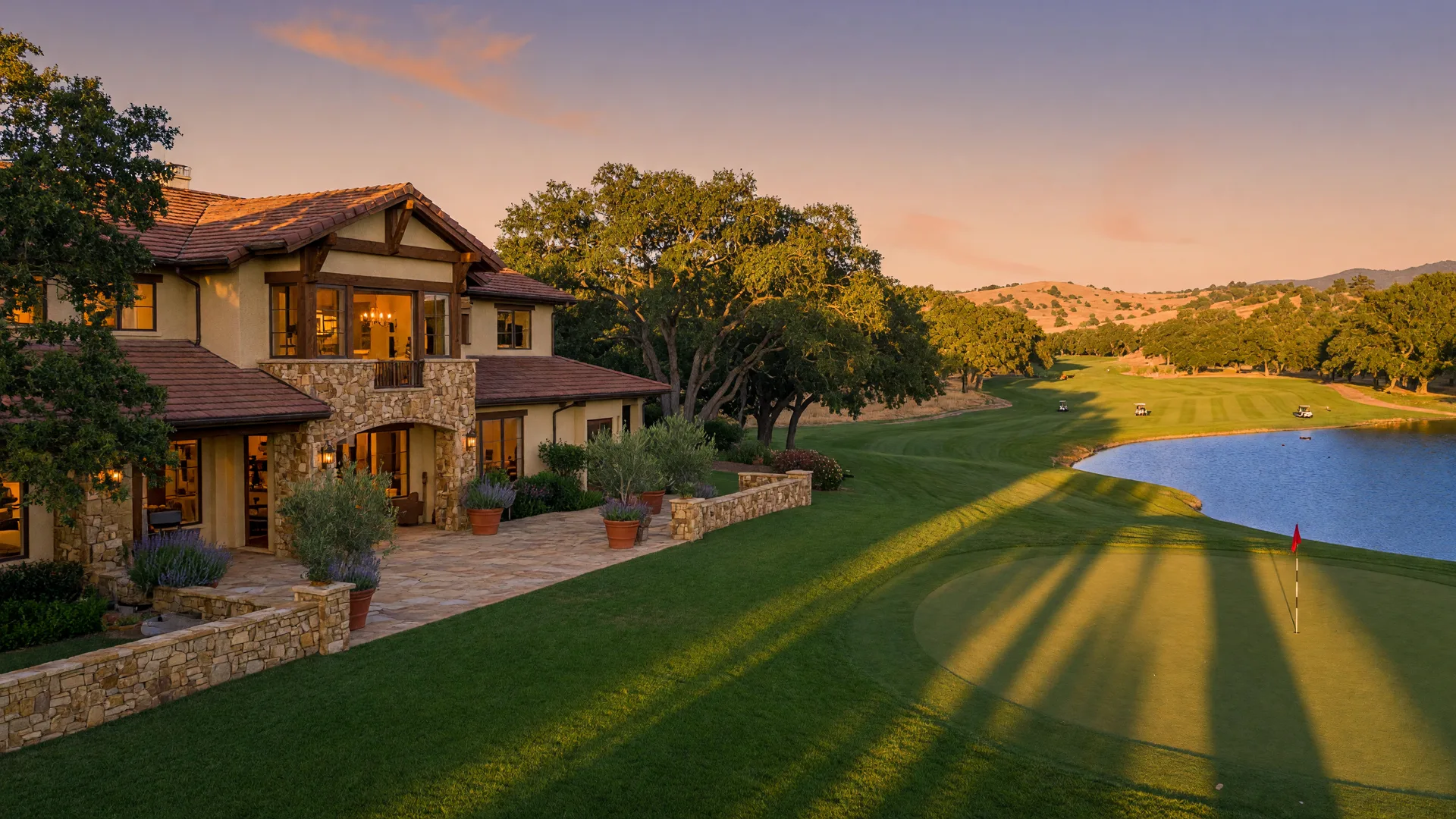
A fairway view is often the cheapest part of the house. The listing leads with the golf course and the sunset photos, but the monthly bill shows up in the HOA packet and the course's own finances, and almost nobody reads those first. I have sold homes on courses from Serrano to Darkhorse for 37 years, and the buyers who ask the right questions stay happy with the view, while the ones who skip them end up calling me about a broken sliding door. Here is what that green grass actually costs in Sacramento, Placer, and El Dorado Counties.
The View Is Priced Twice
The first price sits on the front of the deal. Research on golf communities finds that a home on the course sells for about 5 to 12 percent more than the same house a block off the fairway. That premium is real money, and in this region most fairway-front homes I sell start north of a million dollars and run up past two and a half. Fair enough, if the premium holds when you sell. It does, as long as the course stays healthy, and that is the part this whole post is about.
The second price is the one nobody brags about at dinner: the dues. In Serrano in El Dorado Hills, the HOA runs roughly $250 a month depending on the village, and it covers the gates, the roads, and the common landscaping, the upkeep that keeps a master-planned community looking like the brochure. In Morgan Creek in Roseville, the HOA runs more like $200 to $400-plus a month, and part of that pays for the 24-hour manned security gates. Whitney Oaks in Rocklin, Granite Bay Golf Club, Catta Verdera in Lincoln, they all carry the same shape of bill, with different numbers.
Then comes the question that trips nearly everyone: is the country club part of the dues, or a separate ticket? In Morgan Creek, the course is public, pay as you play, green fees around $75 a round, no membership required, no initiation to chase. In Serrano, the country club is separate from the HOA and membership is optional, but it is a serious number: the golf tier is capped at 450 members, and while the club does not publish its fees, initiation has been reported around $40,000 with monthly dues near $1,400. You can live on a Serrano fairway, pay the HOA, and never join the club. Or you can join, and the monthly cost of the full lifestyle rises to something that looks like a second mortgage. Know which column you are in before you sign.
The Golf Ball Always Finds Your Window
The uncomfortable truth: balls come at the houses. It is the one thing every fairway homeowner will tell you in private and almost nobody puts in the listing. Homes near tees, doglegs, and tight corners catch the most, and a bad week can put several balls in your yard. Even the quieter spots get strays.
Here is the part that stings. Courts generally apply something called assumption of risk, which is a polite way of saying that a home built next to an existing golf course means you knew the game was coming. When a ball takes out your window, the golfer rarely steps forward, the course is not responsible, and your homeowners insurance pays, minus your deductible. A single broken window can run into the thousands. Protective netting helps the worst spots, but it is not cheap, it sags and tears in the sun, and the HOA will have opinions about how yours looks.
None of this is a deal breaker. It is a budget line. Families who plan for it shrug it off; families who never heard of it feel robbed the first season.
The 6 AM Mower Is Your New Alarm
A golf course does not maintain itself. The crew starts before the golfers, which means mowers and blowers at dawn on the days the grass needs it. Tournaments bring carts, crowds, and parking. Golfers retrieving balls will walk your property line like it is a public path, because to them it mostly is.
Privacy is the real trade you are making. You trade a wall of neighbors for a wall of green, and the green has people on it. If you want to sit on the patio in silence on a Saturday morning, a fairway lot is a strange place to look. If you like watching the game, meeting neighbors over a lost ball, and never mowing that forty yards of green yourself, it can be the best seat in the county.
You Are Buying the Course's Business Plan
You did not just buy a house. You bought a seat at a business you do not control. Your view, your quiet, your resale value, all of it rides on a golf course staying funded, irrigated, and attended to. When a course struggles, the first things to go are the extras, then the maintenance, then the membership. Special assessments come down on the neighborhood to make up the difference. In the worst cases, courses close, and a fairway-front home with no fairway loses the premium that made it special in the first place.
So before you write an offer, find out who owns the course, what its finances look like, and what the neighborhood's last assessment was. There is an old saying I lean on: you know what you know, you know what you don't know, and you don't know what you don't know. The course's books live in that last bucket for most buyers, and it is exactly the bucket I dig through on your behalf.
Where the Fairways Actually Are
A quick map of the golf course communities I actually sell in, so you can picture the choice.
Serrano, El Dorado Hills
The big one. A gated master-planned community built around Serrano Country Club, a Robert Trent Jones Jr. design, with villages of homes along the fairways. This is the center of country-club living in El Dorado County, and it sells like it.
Empire Ranch, El Dorado Hills
The other EDH golf address, a sprawling course community with its own clubhouse feel and homes at several price points.
Morgan Creek, Roseville
Gated, 546 acres, fairways wrapping around ponds and trails. The course is public, which keeps the monthly cost more honest than the private-club model.
Whitney Oaks, Rocklin
A course community on the Roseville-Rocklin line, popular with families who want club living without the Granite Bay entry fee.
Granite Bay Golf Club
Private club, homes around the course and the big oak lots that made Granite Bay famous. Expect gate life and a waiting list.
Catta Verdera, Lincoln
Lincoln's only fully gated golf community, built around its own country club, with Twelve Bridges nearby as the bigger master-planned cousin with its own course. Retirement-age buyers also know Sun City Lincoln Hills, the Del Webb community with two courses.
Darkhorse, Auburn
The small one, about 68 homes on half-acre lots off Highway 49 at Combie Road. Golf as a quiet foothill neighborhood rather than a resort, and all the better for it.
The Good Part, Because There Is One
I have spent this much time on the bills and the golf balls because nobody else will. But I sell these homes because plenty of people genuinely love them, and the reasons are not the ones in the brochure.
The view cannot be built out. Nobody is going to put tract homes on the 7th fairway. Your backyard opens onto open space that the neighborhood has a direct interest in keeping green, and that is rare in this region.
The fire angle matters more every year in the foothills. In El Dorado Hills and Auburn, a tended fairway between your house and the ridgeline is one less wall of brush for a wildfire to run through. Pair it with a proper defensible-space plan, and a course-front lot in the wildland-urban interface, and a course-front lot can be a smarter risk than the wooded lot behind it.
And the mornings. I have stood on fairway patios in Serrano and Granite Bay with coffee while the mist burned off the green, and I will not pretend it is not a fine way to start a day.
Eight Questions to Ask Before You Offer
Print this list and take it to the table. Any agent can get you the answers; the point is to ask before the view does the deciding.
01
Who owns the course, and who maintains it day to day?
Owner-operator, management company, or member owned? Each one answers to different pressures.
02
Is club membership bundled, required, or optional?
Morgan Creek and Serrano answer this very differently, and it changes the monthly math by thousands.
03
What is the assessment history, and is one on the horizon?
A healthy course rarely needs a big special assessment. Ask what the last one was for.
04
Who pays when a ball breaks the glass?
Hint: it will be you. Get an insurance quote for this exact house before you offer.
05
Can the yard be fenced or netted?
The CC&Rs decide, and some villages have opinions about netting taller than the mailbox.
06
What have fairway homes resold for lately?
Compare last year's fairway-front sales against the same model two streets off the course.
07
What happens if membership keeps sliding?
Is there a plan, a reserve, a backer? Or does the neighborhood just eat the shortfall?
08
If the course closed tomorrow, what would your street become?
Check the zoning and the deed restrictions, not the rumor mill. The answer is on paper somewhere.
Let's Read the Fine Print Together
Fairway homes are a specialty of mine across this region, from Serrano to Darkhorse, and I know which dues are honest and which ones hide surprises. Tell me the community you are looking at and I will walk you through its numbers straight, including the ones that say the deal is not for you. Thirty minutes is all it takes.
Talk to you soon.